
Hello and welcome! We are thrilled you stopped by Nayak’s Hearing Care, your trusted partner in hearing health.
It’s an interesting thing, hearing loss. Unlike a sudden fever or a sprained ankle, it often sneaks up on us, a slow, quiet, almost imperceptible thief. You might not wake up one day and suddenly realise, “I can’t hear!” Instead, it usually starts with a subtle shift, a little frustration, a small adjustment that you make without even thinking about it. Maybe you blame your spouse for mumbling, or perhaps you think that new café is just unnecessarily loud. Over time, these small adjustments and the occasional embarrassment start to add up.
If you have found yourself nodding along already, or if a loved one has started dropping hints (or maybe even outright complaining!), then this article is for you. At Nayak’s Speech and Hearing Hearing Clinic, we believe that early detection is absolutely key to maintaining a vibrant, connected and fulfilling life. A comprehensive hearing test is a simple, pain free first step and it opens the door to solutions that can truly transform your day-to-day experience.
It’s important to understand that acknowledging a potential problem isn’t a sign of weakness; it’s a brilliant step towards self-care and a commitment to your quality of life. Think of it like getting your eyes checked, it’s routine maintenance for one of your most vital senses. Ignoring the early signs only makes the problem more difficult to manage later. The world is a symphony of sound and you deserve to hear every note, every laugh and every whispered secret.
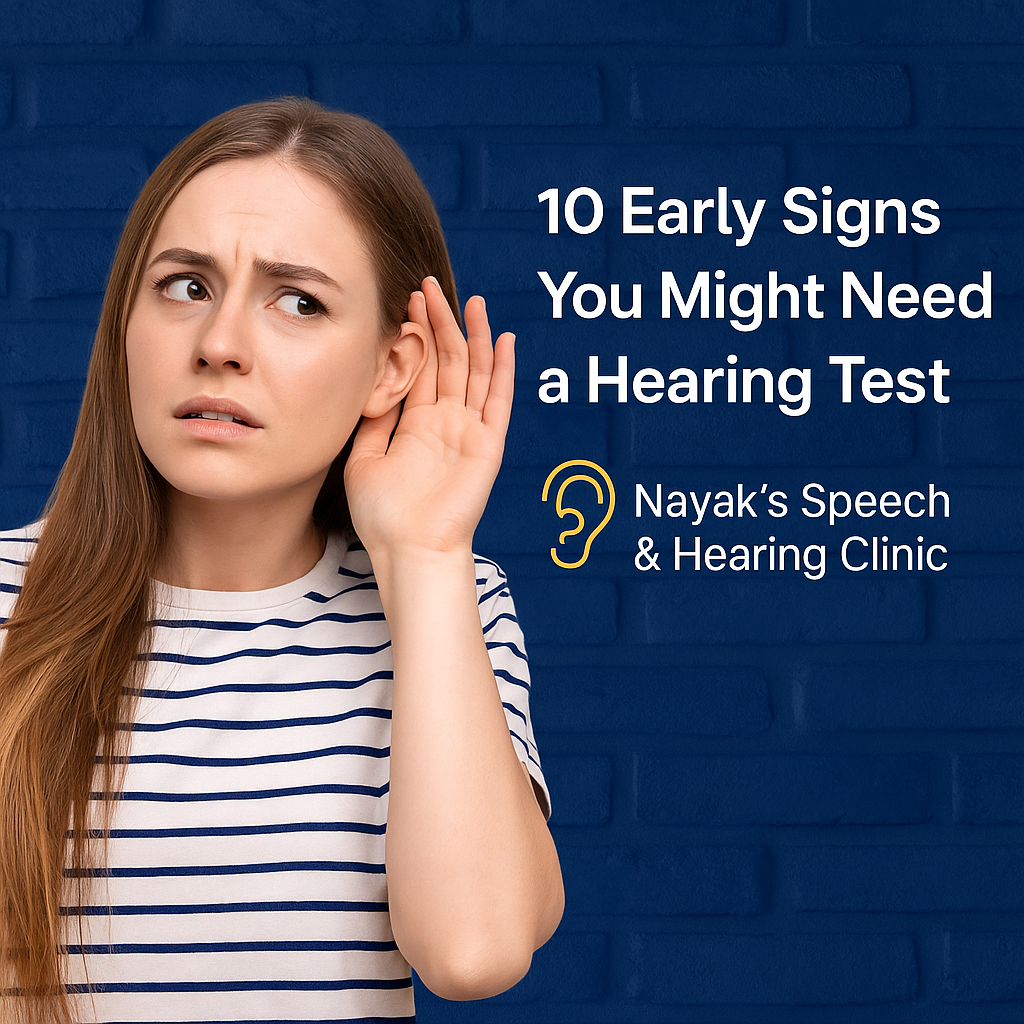
So, let’s stop guessing and start knowing. We hhave put together the 10 most common and often-missed early signs that suggest it might be time to book that hearing test. Read through them, be honest with yourself and remember, we’re here to help you every step of the way.
The Subtle Shift: Why Early Detection Matters So Much
Before diving into the signs, let’s quickly talk about why we emphasise catching this early. Many people wait, on average, seven to ten years from the onset of hearing loss before seeking help. This delay isn’t just about missing out on conversations; it has profound implications for your cognitive health, emotional well being and social life.
When you struggle to hear, your brain has to work overtime to fill in the missing pieces. This constant strain is called listening fatigue (we’ll cover this soon!) and it can be exhausting. Furthermore, recent research strongly suggests a link between untreated hearing loss and an accelerated risk of cognitive decline and dementia. Why? Because when the part of your brain that processes sound isn’t getting adequate stimulation, that energy and capacity can start to diminish. By addressing hearing loss early, you are not just treating your ears, you are investing in your brain and your future independence. We want you to live your life to the fullest and that starts with making sure your communication channels are crystal clear. It’s truly a game changer and the sooner you act, the better your longterm outcome will be.
The 10 Early Signs That Signal a Trip to Nayak’s Hearing is Due
Here are the tell tale indicators, the moments where you might unconsciously compensate for a loss you haven’t even named yet. Take a moment to reflect on whether these situations sound familiar to your daily life.
1. You are Constantly Asking People to Repeat Themselves
This is, by far, the most classic and common sign. It’s more than just an occasional “pardon?” or “what was that?” when someone mumbles. This is a habitual, almost reflexive part of your conversation style now. You find yourself leaning in, cocking your head and using phrases like, “Can you say that again, please?” or “I didn’t quite catch that,” multiple times during a single chat.
The underlying issue: It’s not that the speaker is speaking too softly, it’s that your auditory system is struggling to capture the full spectrum of speech sounds. Specifically, it’s often the soft, high-frequency consonants (like ‘s‘, ‘f‘, ‘h‘, ‘th‘) that go missing. When these vital components of speech are lost, the brain gets an incomplete message, forcing you to ask for a repeat. If this is happening with close friends or family whose voices you know well, or with colleagues in a quiet office environment, it’s a red flag. It’s also often easier to blame the environment or the speaker, but when multiple people across different settings are suddenly “mumbling,” the common denominator is likely your hearing. Don’t let the need to repeat yourself become a source of frustration for you or your conversational partners, it’s a clear signal your ears need professional attention.
2. Difficulty Following Conversations in Noisy Places
The bustling cafe, the family dinner with kids laughing, the professional networking event, these are the real battlegrounds for early hearing loss. If you can hear perfectly fine in a quiet room but completely lose the plot when there’s background noise, that’s a very specific and strong indicator. This phenomenon is known as the “cocktail party effect.”
The underlying issue: A healthy auditory system is exceptional at separating the target sound (the person you’re talking to) from the background noise (the clatter, music and other chatter). This is called speech-in-noise processing. When hearing loss begins, this delicate filtering mechanism is one of the first things to weaken. Your brain can no longer effectively suppress the background noise, meaning the voices you want to hear simply get drowned out. You might be able to hear that a sound is happening, but you can’t discern the words. Consequently, you start avoiding noisy social situations, turning down invitations, or sitting in miserable silence while everyone else seems to be enjoying themselves. This is a profound loss of social connection and it’s one we address directly with modern hearing technology.
3. Turning Up the TV or Radio Volume Too High
This sign is often noticed first by your housemates, spouse, or neighbours, who might complain that the volume is “blasting” or “shaking the walls.” While you feel the volume is just right or perhaps even still a bit too soft, everyone else in the room is wincing.
The underlying issue: The problem here isn’t the volume of the sound, it’s the clarity. Hearing loss often affects certain frequencies first. To compensate for missing information (like those high frequency consonants we mentioned), the natural instinct is to simply make everything louder. While increasing the volume slightly might help, pushing it past a certain point only makes the overall sound louder without necessarily making the speech clearer. It’s like turning up the brightness on a blurry photo, it’s brighter, but still blurry. Moreover, this behaviour can become a safety issue, if you can’t hear the doorbell, the phone ringing, or a smoke alarm unless the TV is deafeningly loud, your home safety is compromised. A hearing test can determine exactly which frequencies you are missing and provide a precise solution, eliminating the need for excessive volume.
4. Tinnitus: The Constant Ringing, Buzzing, or Humming
Tinnitus is the medical term for experiencing sound when no external sound is present. This can manifest as a ringing, buzzing, clicking, humming, roaring, or hissing sound in one or both ears, and it can be intermittent or constant. While tinnitus itself is not a disease, it is a symptom and is very often one of the first and most noticeable indicators of an underlying hearing issue.
The underlying issue: In over 90% of cases, tinnitus is associated with some degree of hearing loss. It’s believed to be the brain’s way of reacting to a lack of external auditory input. When the hair cells in the inner ear are damaged, they stop sending certain signals to the brain. The brain, confused by the lack of activity, essentially creates its own sound to compensate for the missing frequencies. This phantom sound is what we call tinnitus. While there is no “cure” for tinnitus, successfully treating the underlying hearing loss with amplification can often reduce the perception and bother of the tinnitus significantly. If you’ve been living with this persistent internal noise, it’s a very strong signal that a full hearing assessment is crucial.
5. Difficulty Hearing High-Pitched Sounds
Have you ever missed the gentle chirp of a bird, struggled to understand your grandchildren’s playful chatter, or found that you can hear the bass in music but the treble seems muffled? These are all examples of losing the ability to perceive high-frequency sounds.
The underlying issue: The delicate sensory hair cells in the inner ear (cochlea) responsible for processing high frequencies are located at the very beginning of the cochlea, making them the most exposed to noise damage and the natural ageing process. For this reason, high frequency hearing loss (presbycusis) is the most common type of age related hearing loss. This is why women’s and children’s voices, which naturally have higher pitches, often become the most challenging to understand. You might hear the sound of their voice, but the key consonant details, which provide clarity and meaning, are lost. Missing these sounds doesn’t just impact communication, it robs you of the simple, beautiful high-frequency details of the world, like the subtle sounds of nature or the crispness of a violin.
6. Feeling Drained or Exhausted After Social Gatherings
You went to a party, chatted with a few friends and now you’re home, feeling completely wiped out, almost as if you ran a marathon. This isn’t just social fatigue, this might be “listening fatigue,” a less obvious but highly impactful sign of early hearing loss.
The underlying issue: As we discussed, when you have hearing loss, your brain is constantly straining to fill in the missing auditory information, especially in complex listening environments. This isn’t a passive process, it’s a massive, resource intensive cognitive effort. Your brain is working overtime, deploying extraordinary resources just to keep up with a basic conversation. Even if you don’t realise you are struggling, your brain is actively guessing, anticipating and interpolating words. This sustained, high level processing drains mental energy rapidly. People with unaddressed hearing loss often start avoiding social events not because they don’t enjoy them, but because the effort of listening makes the experience physically and mentally punishing. If simple social interactions are leaving you exhausted, your hearing health is likely the culprit, and a hearing aid can drastically reduce this cognitive load.
7. Missing Phone Calls, Doorbells, or Alarms
This sign speaks directly to a breakdown in awareness of crucial environmental cues. It’s the constant worry that you won’t hear the phone ring, the increasing reliance on flashing lights instead of audible alerts, or the frustration of a delivery person saying they rang the bell five times.
The underlying issue: These sounds, the high-pitched ring of a classic telephone, the quick chime of a doorbell, the synthetic beep of a microwave timer, often exist in those higher-frequency ranges that are the first to deteriorate. If your hearing loss is unilateral (worse in one ear), you might miss a sound coming from the side of your affected ear. Beyond frequency issues, this can also be a sign that your brain’s reaction time to less frequent, non-speech sounds is slowing down due to lack of stimulation. Missing these cues is more than an inconvenience, it can be a significant safety concern, particularly when it comes to fire alarms or emergency alerts. If family members are resorting to calling you on video chat just to make sure you hear the phone, it’s a clear signal to visit Nayak’s Hearing Care Clinic.
8. Hearing Well in One Ear, But Not the Other
You might find yourself constantly orienting your “good ear” towards the speaker, or perhaps you instinctively favour one side of the telephone. This is known as unilateral hearing loss (hearing loss in one ear) or asymmetrical hearing loss (loss that is significantly worse in one ear than the other).
The underlying issue: While hearing loss is often symmetrical (affecting both ears equally), it can certainly be uneven. An asymmetrical loss can be caused by various factors, including acoustic trauma (like a loud blast near one ear), an underlying medical condition (like an infection or tumour), or simply a faster decline in one ear. Crucially, your two ears work together to provide localization (knowing where a sound came from) and clarity (using the “better” ear to help process sound in the “worse” ear). When one ear is significantly struggling, this teamwork breaks down, making it extremely difficult to listen in noise, as your brain can’t easily compare the signal from both sides. Any sudden or significant change in hearing in just one ear warrants an immediate check up, as it can occasionally point to conditions that require prompt medical attention. Don’t wait on this one!
9. Misunderstanding Words and Confusing Similar Sounds
This is the classic example of frequently misunderstanding what was said, leading to humorous but often frustrating errors. You might think someone said “cat” when they said “hat,” or “shoe” when they said “blue.” It’s not that you didn’t hear a sound, it’s that you misidentified the word.
The underlying issue: This problem is almost always due to the loss of those tiny, high frequency consonants we’ve harped on: s, t, f, th, sh, ch, k, p. These sounds are the cues that differentiate one word from a phonetically similar one. For instance, the difference between “show” and “though” is primarily the ‘sh’ versus ‘th’ sound, which are both high-frequency. If your brain doesn’t receive the ‘sh’ sound, it has to guess the word based on context and the lower-frequency vowel sounds. While sometimes the guess is right, other times it’s wildly wrong, leading to those awkward misunderstandings. This constant misinterpretation can lead to anxiety and a reluctance to speak up, as you second-guess whether you actually heard correctly. A professional test can pinpoint exactly which consonants are getting lost in translation.
10. Withdrawal and Isolation from Social Activities
This is the emotional and behavioural consequence of unaddressed hearing loss, and perhaps the saddest of the signs. You start cancelling dinner plans, stop attending family functions, or actively avoid group settings where conversation is flowing freely. The reason? It’s simply become too hard and too tiring to participate.
The underlying issue: The previous nine signs, the exhaustion, the confusion, the constant asking for repeats, the inability to cope with noise, culminate in this social withdrawal. When communicating requires intense, miserable effort, the natural human response is to retreat from the source of the difficulty. Sadly, isolation is a major risk factor for depression, anxiety and the aforementioned cognitive decline. By pulling away, you are protecting yourself from frustration, but you are also severing the vital social and cognitive connections that keep your mind sharp and your spirit healthy. If you or a loved one has noticeably started shrinking their social circle or avoiding beloved hobbies because of “trouble hearing,” this isn’t just a hearing problem, it’s a life problem that urgently needs to be addressed. Reconnecting with the world starts with reclaiming your hearing.
Your Next Step: Why Choose Nayak’s Hearing Care Clinic?
If you have identified with even a few of these ten signs, please understand that you are not alone, and you don’t have to live this way. Hearing loss is one of the most treatable sensory conditions, and the solutions available today are discreet, incredibly advanced, and life-changing.
At Nayak’s Hearing, we are dedicated to providing comprehensive, personalised hearing care.
We offer:
Expert Diagnostics: A thorough, professional hearing test by experienced audiologists who will accurately map your specific hearing profile and pinpoint the exact nature of your challenge.
Personalised Solutions: We don’t believe in one-size-fits-all. We offer a wide range of cutting-edge digital hearing solutions, tailored precisely to your loss, lifestyle, and budget.
Ongoing Support: Our relationship doesn’t end when you leave with a hearing aid. We provide continuous follow-up care, adjustments and counselling to ensure you are getting the absolute maximum benefit from your devices.
Your hearing is the gateway to communication, connection, and cognitive vitality. Don’t let a subtle shift in your hearing health close that gateway. Taking action today means preserving your social life, your professional edge and your mental sharpness for years to come.
Ready to hear the difference?
Conclusion
It’s easy to dismiss these signs, to attribute them to stress, fatigue, or the shortcomings of others. But deep down, you know the truth: you are missing out. You’re missing the quiet jokes, the crucial instructions, and the simple joy of effortless conversation.
The good news is that recognizing these 10 early signs is the hardest part. The easiest part is what comes next: taking action.
A hearing test at Nayak’s Hearing is a non-invasive, simple procedure, it’s just a check-up, not a commitment to a solution. It’s simply the key to giving you the knowledge you need to make an informed decision about your future.
Don’t wait another week, month, or year. Don’t let your world grow quieter or your social life shrink any further. Take control of your hearing health today.
Click the link below or visit our centre to schedule your comprehensive hearing assessment. Let us help you rediscover the vibrant world of sound you have been missing.
Schedule Your Hearing Test Today at Nayak’s Hearing Speech and Hearing Clinic!
We look forward to welcoming you and helping you hear your best!